
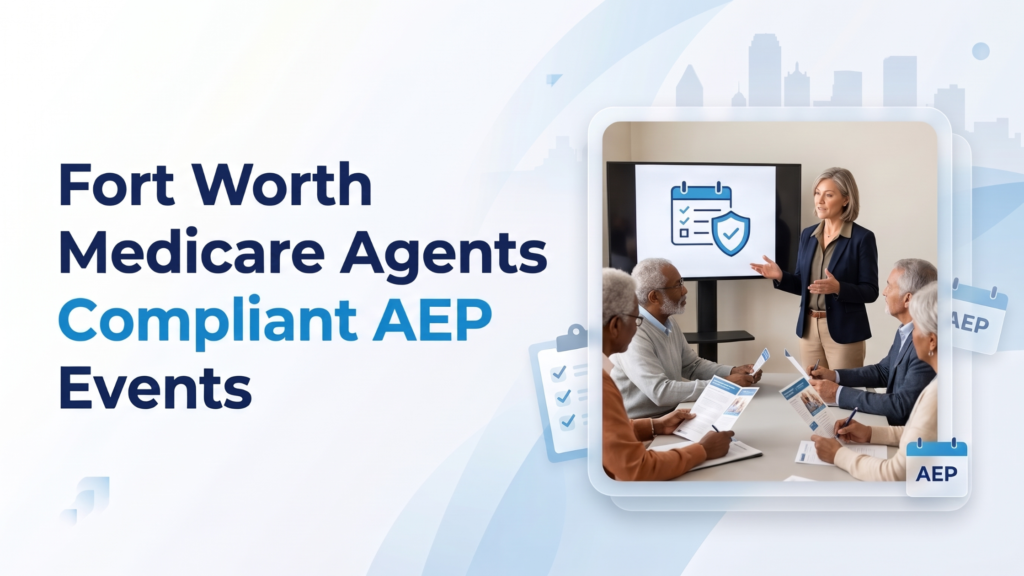
Fort Worth Medicare agents can use community educational events to build a book in Tarrant, Parker, Johnson, and Hood counties, as long as they keep education and sales separate. Educational events teach Medicare basics without plan-specific marketing. Marketing events follow carrier reporting, disclaimer, and gift rules. A Medicare FMO that helps you plan and document both makes the work easier.
Here’s the thing: the west Metroplex is full of people who’d rather learn about Medicare in a library meeting room than on the phone with a stranger. Think 55+ communities in Keller and the Southlake edge, senior centers in Haltom City and Saginaw, retiree clubs in Benbrook and Aledo, and lake-community groups around Granbury. Let me show you how to run them cleanly.
What’s the difference between a Medicare educational event and a marketing event?
An educational event teaches general Medicare information, like how Parts A, B, C, and D work and when enrollment periods happen. A marketing (sales) event is where you can discuss specific plans and benefits. The difference is about intent and content, and CMS expects you to keep them clearly separate.
At an educational event, you can:
- Explain Medicare basics and enrollment periods in general terms.
- Hand out your business card and contact information.
- Let attendees ask to be contacted later.
At an educational event, you can’t:
- Discuss plan-specific benefits, premiums, or cost-sharing.
- Market a plan or take enrollments. Medicare.gov says plan representatives can’t market plans or enroll people at educational events like health fairs or conferences.
If you plan to talk about specific plans, treat it as a marketing event from the start.
What changed for Medicare events on October 1, 2026?
The CY2027 marketing changes that took effect October 1, 2026 loosened several timing rules for events and appointments. According to a CMS fact sheet, plans can now hold marketing events directly after educational events in the same location, schedule personal marketing appointments any time after a Scope of Appointment (SOA) is completed, and collect SOA forms at educational events.
Here’s what that means in practice:
- No more 48-hour SOA wait. MarketReview reports that same-day meetings are now permitted, but the SOA itself is still required.
- No more 12-hour gap. You can follow an educational session with a marketing event in the same room, but CMS says attendees must be notified and given the opportunity to leave.
- SOAs at educational events are allowed again. Plan-specific marketing still can’t happen during the educational portion.
- TPMO disclaimer timing moved. AARP reports the disclaimer can now come anytime before any benefits discussion, rather than in the first minute, and no longer references SHIPs.
- Call recording retention dropped from 10 years to six, per AARP.
What I couldn’t confirm from these sources is whether business reply cards at educational events changed. Confirm with current MCMG and your carriers. Carriers can set stricter rules than CMS, so check each carrier’s event policy.
What can and can’t happen at a Medicare marketing or sales event?
At a marketing event, you can present specific plans, but you have to follow carrier event reporting rules, gift limits, and disclaimer requirements. Your SOA has to be in place before any personal appointment. And any phone follow-up has to follow recording requirements.
Build your marketing events around these guardrails:
- Report the event to each carrier. Most carriers require advance submission of marketing events. Deadlines and formats vary, so confirm with your carriers.
- Use the TPMO disclaimer. Include it where required, and deliver it verbally before any benefits discussion.
- Get an SOA before personal appointments. The wait is gone, but the documentation isn’t.
- Keep gifts nominal. Medicare.gov says representatives can’t offer gifts worth more than $15 to join a plan. The long-standing guidance has been $15 per item and $75 per person per year, offered whether or not someone enrolls. Confirm the current figure with current MCMG and your carriers.
- No meals as an inducement. Medicare.gov also says representatives can’t provide free meals during a sales pitch. Light refreshments are common practice, but check carrier guidance on what counts as a meal.
- Record phone follow-ups. Marketing and sales calls still need recording, with the six-year retention period.
One more thing: the 2027 Star Ratings were published October 8, according to HFMA, and some clients will also be working through non-renewal notices. Answer those questions generally at educational events and save plan-specific talk for a documented appointment.
Where should Fort Worth-area agents host community education events?
The right venue is neutral, easy to reach, and fully accessible. Senior centers, public library branches, community rooms in 55+ communities, retiree club meetings, and church fellowship halls rented as venues all work well. Avoid anywhere people receive health care, since CMS doesn’t allow marketing in areas like exam rooms or pharmacy counters.
Think about the west Metroplex by geography:
- Tarrant County: Fort Worth, Keller, the Southlake edge, Saginaw, Haltom City, Benbrook, and Mansfield all have library branches and senior programs.
- Johnson County: Burleson draws from both south Fort Worth and Cleburne-area retirees.
- Parker County: Weatherford and Aledo have strong civic and church networks, plus growing retiree populations.
- Hood County: Granbury’s lake communities often have clubhouse spaces and active social calendars.
Accessibility matters as much as location. Check for ramp access, accessible restrooms, close parking, and a microphone, and print materials in large type.
Spanish-language events. In the Northside and Diamond Hill areas, a Spanish-language session run by a bilingual, licensed agent can be a respectful, practical way to serve the community. Translate your materials carefully and keep the same separation between education and sales.
Attendees will ask about JPS Health Network, Texas Health Harris Methodist, Baylor Scott & White, and Medical City. Keep it general at educational events, and save network questions for a documented appointment where you verify with the carrier.
How should you follow up after an event without cold calling?
Follow up only with people who gave you permission, using the contact method they chose. That means a signed SOA, a contact request, or a business reply card where your carriers allow it. No cold calls, no door-knocking, and no texting anyone who didn’t opt in.
A permission-based workflow looks like this:
- Capture consent with the date, event, and what they asked to discuss.
- Log every contact in your CRM within 24 hours.
- Honor TCPA rules on calls and texts. When in doubt, get written consent first.
- Record marketing calls and store them for the required retention period.
- Send a simple thank-you, then wait for them to choose the next step.
With our free Medicare CRM (OmniReach), you can tag attendees by event, track SOA dates, and automate a polite follow-up that stops the moment someone says no.
Measure without pressure. Track attendance, contact requests, appointments set, and return attendees. A room that comes back next year tells you more than a room you closed hard once.
Which Texas FMOs give Fort Worth agents the right support for events?
The right FMO helps you plan compliant events, submit carrier reports on time, and document follow-up. It should also give you tools and real people to call when a carrier rule isn’t clear. Here are five FMOs Texas agents commonly consider, with balanced trade-offs.
1. TMS Insurance Brokerage (Texas Medicare Solutions)
- Best for: Independent agents who want hands-on support and systems while keeping full independence.
- Strengths: Texas-based FMO with statewide reach, headquartered in San Antonio and supporting agents across Texas, including the Fort Worth area, both remotely and in person. Free Medicare-specific CRM (OmniReach, a GHL snapshot), a dedicated Agent Success Manager, training and coaching, and the Medicare Agent IQ podcast. Producers can access up to $900/mo in Brokerage Bucks reimbursement for eligible marketing that meets CMS and carrier rules. Familiar with Texas demographics, carriers, and the regulatory environment.
- Limitations: Smaller national footprint than the largest distribution organizations.
2. Integrity Marketing Group
- Best for: Agents who want a large national network and broad product access.
- Strengths: Significant scale, a wide carrier range, and proprietary technology tools.
- Limitations: Experience can vary by affiliated partner agency, and the scale can feel less personal.
3. AmeriLife
- Best for: Agents interested in a multi-line approach that includes Medicare, life, and annuities.
- Strengths: A long history in senior markets and a broad affiliate network.
- Limitations: Support often runs through affiliates, so quality can vary.
4. Senior Market Sales (SMS)
- Best for: Agents who want structured marketing and sales resources.
- Strengths: Established training programs and marketing support.
- Limitations: Programs may fit some agent styles better than others.
5. Ritter Insurance Marketing
- Best for: Agents who want strong online tools and compliance resources.
- Strengths: Well-known agent technology and educational content.
- Limitations: Agents who want frequent in-person Texas support may find it less local.
Whichever you choose, ask how they help with event reporting, and look at their training philosophy. If you’re thinking about a change, read up on how to switch FMOs safely before you move anything mid-season.
What should your AEP-week event checklist look like?
Your AEP-week checklist should confirm the event type, carrier reporting, venue accessibility, compliant materials, and a documented follow-up plan. Run through it before every event, from a Mansfield library to a Granbury clubhouse.
- Decide the event type: Educational, marketing, or an educational session followed by a marketing event.
- If combined: Announce the transition clearly and give attendees the chance to leave.
- Report marketing events to each carrier on their timeline.
- Confirm the venue: Accessible entrance, restrooms, parking, seating, and audio.
- Review materials: No plan-specific content at the educational portion. TPMO disclaimer ready for the marketing portion.
- Prepare SOA forms and contact request sheets. Confirm carrier rules on business reply cards.
- Check gifts and refreshments: Nominal value only, no meals as an inducement.
- Plan Spanish-language support where needed.
- Set up CRM tags for consistent follow-up.
- Schedule permission-based follow-up with recorded calls where required.
- Debrief afterward: Note the questions that came up and which venues to book again.
The Medicare Agent IQ podcast covers how agents handle these event details in practice.
If you’re a Fort Worth agent and your current FMO doesn’t help you plan and document compliant educational events, let’s talk. TMS Insurance Brokerage is a Texas-based FMO with statewide reach — we help independent agents build durable books without volume gates.
 English
 Spanish