
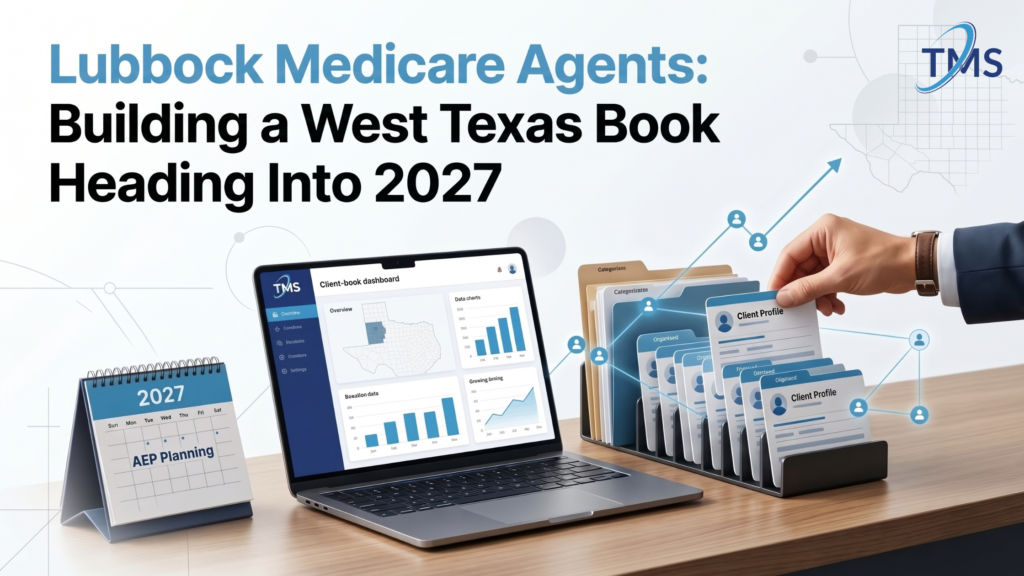
Lubbock and South Plains Medicare agents work across a large geographic area where provider access, prescription coverage, travel distance, and rural health care can shape the client conversation.
For independent agents, the opportunity is not to assume that West Texas clients prefer one type of Medicare coverage.
It is to understand how each beneficiary receives care, which providers and clinics they use, how far they travel for specialists, what prescription coverage they need, and which Medicare option best fits those circumstances.
Heading into the 2027 plan year, agents should also prepare for Part D changes, Medicare Advantage non-renewals, and a heavier annual-review workload.
Why Does West Texas Require a Different Medicare Workflow?
A beneficiary living in Lubbock may receive most of their care in one health system.
A beneficiary in Levelland, Brownfield, Tahoka, Morton, Muleshoe, or another South Plains community may use a local clinic for primary care and travel to Lubbock for specialists, imaging, or hospital services.
That pattern makes several questions especially important:
- Where does the client receive primary care?
- Which specialists do they see?
- How far do they travel for care?
- Are their providers in the plan’s network?
- Do they want broader provider access?
- Which prescriptions do they take?
- How important are predictable monthly versus point-of-service costs?
Do not assume Medicare Advantage or Medigap is automatically the better choice based on ZIP code or rural residence.
Start with the client’s actual care pattern.
How Should Agents Compare Medicare Advantage and Medigap in West Texas?
Medicare Advantage and Original Medicare with Medigap operate differently.
For clients reviewing Medicare Advantage, agents should pay close attention to:
- Provider networks
- Hospitals and specialists
- Referral requirements
- Prior authorization
- Maximum out-of-pocket amounts
- Prescription formularies
- Pharmacy networks
- Travel needs
For clients reviewing Original Medicare with Medigap, consider:
- Medigap premium
- Part B premium
- Separate Part D coverage
- Provider access under Original Medicare
- Travel patterns
- Expected out-of-pocket costs
A client who uses primary care locally and travels to Lubbock for multiple specialists may place a high value on provider flexibility.
Another client may prefer the cost structure and benefits available through a Medicare Advantage plan.
The correct approach is to compare the actual options available to that beneficiary.
How Do 2027 Part D Changes Affect West Texas Agents?
For agents with clients using stand-alone Part D coverage, the 2027 plan year requires careful annual review.
CMS announced that the voluntary Part D Premium Stabilization Demonstration ends after 2026.
For 2027, CMS announced:
- A national average monthly bid amount of $296.05
- A Part D base beneficiary premium of $41.33
These figures are national program measures.
They are not necessarily the premium an individual beneficiary will pay.
Actual premiums, formularies, pharmacy arrangements, and cost-sharing vary by plan.
Agents should therefore avoid using national numbers as a substitute for an individual plan review.
What Should Agents Review for Part D Clients?
For every Part D client, review:
- Current medications
- Drug dosage
- Preferred pharmacy
- Formulary status
- Drug tier
- Prior authorization
- Step therapy
- Quantity limits
- Monthly premium
- Deductible and cost-sharing
Do not assume that a prescription plan that worked well in 2026 remains the best fit in 2027.
Use current approved plan-year information.
How Should I Work With Rural Health Clinic and FQHC Clients?
Rural Health Clinics and Federally Qualified Health Centers can be important access points for beneficiaries in rural and underserved communities.
They are not the same type of facility.
Rural Health Clinics
Rural Health Clinics are Medicare-certified providers serving qualifying rural and underserved areas.
Medicare uses a specific RHC payment methodology, including an all-inclusive rate structure for certain covered services.
Agents do not need to become RHC billing experts.
They do need to know where the client receives care and whether the clinic participates appropriately under the coverage being reviewed.
Federally Qualified Health Centers
FQHCs serve underserved communities and use their own Medicare Prospective Payment System.
Health Center Program organizations are also required to provide sliding-fee discounts based on ability to pay.
Do not assume the sliding-fee structure determines how a Medicare Advantage plan will process the client’s care.
Verify the specific clinic, plan, and coverage rules.
What Questions Should I Ask a Rural Client?
Start with:
- Where do you receive primary care?
- Which clinic do you use?
- Which hospital do you normally use?
- Do you travel to Lubbock for specialists?
- How often do you travel for medical appointments?
- Which prescriptions do you take?
- Which pharmacy do you use?
- Do you have Medicaid, Extra Help, employer coverage, VA, or another program?
That information is more useful than beginning with a plan presentation.
How Should Agents Plan Cross-County Appointments?
West Texas travel can consume an agent’s calendar quickly.
Use geographic clustering whenever practical.
Possible clusters include:
North
- Plainview
- Hale Center
- Floydada
West
- Levelland
- Morton
- Muleshoe
South and Southwest
- Brownfield
- Tahoka
- Post
Lubbock Area
- Lubbock
- Wolfforth
- Idalou
- Slaton
These are examples, not mandatory routing rules.
Build the schedule around the location of your actual clients.
Use phone or virtual appointments when appropriate and preferred by the beneficiary.
How Should OmniReach Support a Rural Territory?
OmniReach can be configured to organize clients by:
- County
- City
- Geographic corridor
- Medicare Advantage
- Medigap
- Part D
- Annual review status
- Provider review needed
- Prescription review needed
- Non-renewal
- AEP follow-up
That can help agents build appointment clusters and avoid unnecessary drive time.
CRM automation supports organization.
It does not replace client consent, compliance requirements, or manual verification of plan information.
What Should Agents Look for in an FMO?
Agents should compare FMOs based on operational needs rather than unsupported rankings.
Questions include:
- Is the FMO focused on Medicare?
- Does it support both Medicare Advantage and Medigap business?
- Is CRM technology included?
- Is there a dedicated support contact?
- What carrier contracting support is available?
- How are compliance questions handled?
- Is Medicare training ongoing?
- What marketing resources are available?
- What production requirements apply?
- Does the FMO understand Texas markets?
Where TMS Insurance Brokerage Fits
TMS Insurance Brokerage is a Texas-based FMO supporting independent Medicare agents.
Agent resources include:
- OmniReach CRM
- Administrador de Éxito del Agente Dedicado
- Medicare-focused training
- Carrier contracting support
- Medicare Agent IQ education
- Qualifying Brokerage Bucks marketing support
Agents should review the applicable program terms and production requirements before relying on a specific marketing-support amount.
For a geographically dispersed West Texas book, OmniReach can help organize annual reviews, provider checks, prescription reviews, non-renewals, and appointment routing.
How Do 2027 Medicare Advantage Non-Renewals Affect West Texas Agents?
Medicare Advantage non-renewals require a separate workflow from routine annual reviews.
Use official carrier information.
Do not assume that a beneficiary is affected simply because a carrier is reducing plans elsewhere.
Create two categories:
Watchlist
A client who may be affected based on preliminary carrier information.
Confirmed Non-Renewal
A client whose specific plan has officially been confirmed as ending.
For confirmed non-renewals, document:
- Plan
- Coverage end date
- Providers
- Prescriptions
- Pharmacy
- Potential Medigap Guaranteed-Issue rights
- Applicable Special Enrollment Period
- Follow-up date
How Does Medigap Guaranteed Issue Work After a Non-Renewal?
A qualifying Medicare Advantage non-renewal may create a Medigap Guaranteed-Issue right when the beneficiary returns to Original Medicare.
Do not describe this only as a “63-day window.”
In qualifying situations, a beneficiary may generally apply:
- Beginning 60 days before Medicare Advantage coverage ends
- Through 63 days after the coverage ends
The applicable Medigap plans depend on the beneficiary’s Medicare eligibility date, qualifying event, state rules, and carrier requirements.
Verify the right before making a representation.
What Is the Non-Renewal SEP?
For a Medicare Advantage or Part D plan ending December 31 because of a plan non-renewal, CMS provides an additional Special Enrollment Period.
For the 2027 plan year, the SEP generally runs:
December 8, 2026 through February 28, 2027.
The Medigap GI period and the non-renewal SEP are different timelines.
Track them separately.
What Should Be on a Lubbock Pre-AEP Checklist?
Client Data
- Reconcile active clients.
- Segment MA, Medigap, and Part D clients.
- Update phone, address, provider, medication, and pharmacy information.
Part D
- Pull current medication lists.
- Prepare annual prescription reviews.
- Use finalized 2027 plan information when available.
- Do not assume a 2026 PDP remains appropriate.
Medicare Advantage
- Review ANOCs as received.
- Track official non-renewal notices.
- Verify provider networks.
- Separate watchlist clients from confirmed non-renewals.
Rural Clients
- Document primary clinic.
- Document specialists.
- Identify travel patterns.
- Confirm RHC or FQHC participation when relevant.
Operations
- Complete required annual certifications.
- Confirm E&O requirements.
- Review current SOA procedures.
- Review current TPMO requirements.
- Test CRM reminders and follow-up.
- Cluster appointments geographically.
Build the Book Around Accurate Information
A successful West Texas Medicare practice does not depend on assuming that every rural client wants Medigap or that every urban client wants Medicare Advantage.
It depends on knowing how the beneficiary actually receives care.
A rural client may use a local clinic and travel to Lubbock for specialists.
A Medigap client may need a careful Part D annual review.
A Medicare Advantage client may need a provider-network check.
A client affected by a non-renewal may need two different deadlines tracked at the same time.
The agent’s job is to organize that information, verify the applicable rules, and help the beneficiary evaluate eligible coverage options.
TMS Correduría de Seguros helps independent Texas agents build repeatable workflows through OmniReach CRM, Agent Success Manager support, Medicare-focused training, carrier contracting assistance, Brokerage Bucks, and Medicare Agent IQ education.
For a West Texas agent managing a wide territory, structure matters more than simply adding more appointments.
 English
 Spanish